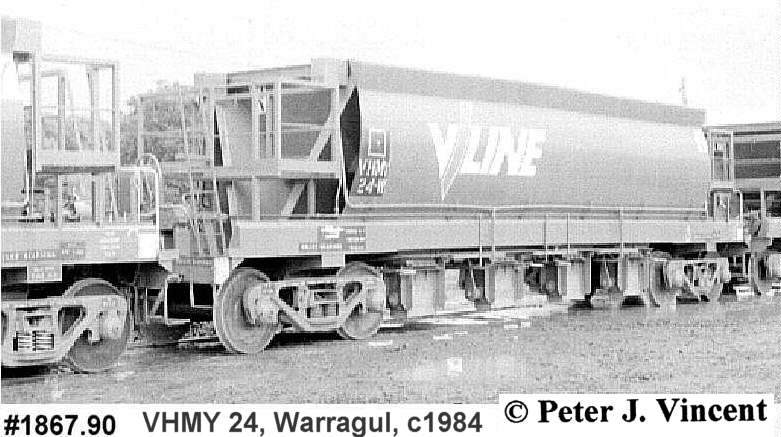
To replace the ageing fleet of ballast hoppers which were built between 1900 and 1950 ( _NN_ and _QN_ ), the railways built a fleet of pneumatically operated discharge hoppers.
The old method required men to walk beside the slow moving train and control the discharge of ballast with the hopper door open/close wheel. No doubt this was dangerous and with increasing 'Health and Safety' issues and safer methods were introduced.
The door discharge operation is a rotating 'drum' with flat inner and outer sides. The 'drum' can be rotated to allow discharge inside or outside of the rails. The operator stands on a high platform at one end.
Some wagons were relettered to VHMF in 1988. Remaining vehicles in the group were relettered to VZMF in 1989.
The VHMF numbers were: 11, 18, 22, 23, 34, 36, 37, 38, 42, 43, 44, 45, 59, 52, 54, 56.
Between 1990 and 1994 the class was again relettered to reflect departmental ( non revenue ) service. The class letters used were VZMF.